
Feeling festive… and a little bit smug (in the nicest possible way).
December 17, 2025
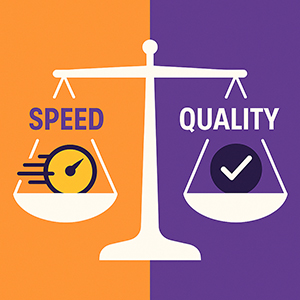
Speed vs. Quality: When “Fast Insights” Risk Becoming Fast Food
November 10, 2025
Let’s be honest — it’s getting harder to find real humans who actually want to take part in research.
Between bots, professional respondents, and plain old fatigue, sample quality is fast becoming the industry’s dirty little secret.
And it’s not just quant panels. Even in qualitative research, we’re seeing participant over-recycling, fake LinkedIn profiles, and “AI humans” slipping through recruitment screens.
What’s going on?
A few factors collide:
• Survey overload – every brand, event, and app wants feedback. People are tired.
• Economic squeeze – incentives have barely shifted in a decade while cost-of-living has soared.
• AI infiltration – bots and GPT-assisted responses now flood open-endeds with plausible-sounding rubbish.
• Ease of cheating – with remote studies, verifying who’s behind the keyboard is harder than ever.
For event or B2B research — our world — this is even trickier. We’re targeting niche, time-poor professionals. The “good” ones are either on a plane, in meetings, or just done with surveys.
Why it matters
Bad samples don’t just skew numbers — they poison insight.
One rogue bot can’t ruin a dataset, but a flood of them? Suddenly your Net Promoter Score looks suspiciously high and everyone’s patting themselves on the back for the wrong reasons.
Worse, if clients lose trust in data integrity, they lose faith in us.
What researchers can do
1. Tighten screening – re-think screener logic, use hidden qualifiers, cross-check with digital fingerprints or video confirmation where possible.
2. Reward fairly – treat incentives as value exchange, not token payment.
3. Mix methods – triangulate data sources: qual, quant, passive, ethnographic. Bots can’t attend an interview or show emotion (yet).
4. Use human QA – don’t outsource validation entirely to tech. Trained researchers still spot odd patterns better than code.
5. Educate clients – explain why “1,000 completes in 24 hours” might sound great but probably isn’t real.
The opportunity
The irony? The harder it gets to find genuine participants, the more valuable qualitative methods become.
Ethnography, in-depths, and live intercepts at events re-introduce something digital data has lost — real people, in real moments, with real emotion.
The bottom line
In a world obsessed with AI-generated everything, human authenticity is the new gold standard.
So maybe the next time someone brags about their 5-minute, 5-quid online survey, we should smile politely — and then go talk to someone real.
Posted by Lisa Holt, Founder & CEO